Showing posts with label Asimov. Show all posts

Saturday, July 06, 2024

The Roman Empire


by Lacey Kat
(Copyright by the author - All rights reserved) 

In September of 2023, Rolling Stone Magazine had an article entitled, “Why Are So Many Men Obsessed With the Roman Empire?”  It addressed a trend on TikTok of women, seemingly at random, asking their husbands and boyfriends how often they think about the Roman empire, and being quite surprised to find most of them respond that they think about it on a daily basis.  While this made for a cute “what is it with men these days” filler, Mike Duncan, historian and host of the popular History of Rome podcast decided it was something worth looking into.  I don’t know if he mentions Isaac Asimov in his writings or podcasting, but “The Great Explainer” saw this trend quite a few decades ago.  

Isaac Asimov was never one to do something halfway.  If you asked him to write a pamphlet, he would give you an essay.  If you asked for an article, he would give you a book.  If you asked for a book, he would give you a series.  

The benefit of all of this is that we, the reading public, reaped the rewards of his prolific writing.  However, his editors, the ones who had to pay him per word, or pay to have his abundance of words printed, often wanted restrictions on how much Asimov included in his assignment.  Asimov hated to edit and the only thing he hated more was to have someone else edit it for him.  If a book was longer than the publishing house had in mind, Asimov wanted to be the one who trimmed it. 

Occasionally Asimov hit upon a happy medium.  A way to satisfy his desire to be complete and balance the publisher’s desire to keep a book under 400 pages.  The solution?  Asimov would write two books on the subject.

That is the case with Asimov’s history of Rome.  Realizing that he could not fit the thousand-year epic into one volume, Asimov wrote a book about the Roman Republic and then wrote a book about the Roman Empire.  This made everyone happy.

“The Roman Empire,” picks up right where the “Roman Republic” left off.  Asimov starts with a quick overview of Roman history from its founding in 753 B.C.E., to the fall of Julius Caesar, and the civil wars that followed, to the rise of Octavian, who we know better as “Augustus.”  From here, Asimov starts the tale.

As in the “Roman Republic,” Asimov deals only briefly with daily Roman life, preferring to concentrate on the battles and politics that shaped history.  He uses his indomitable narrative style to make the reader forget that these were events of over two thousand years ago.  The intrigue, backstabbing, and drama of political life could be set in any capitol today, and not just Rome of the past millennia.  This helps bring interest to what is, to most people, the dry subject of history.

Were appropriate Asimov does interject some tidbits of Roman social life, the plight of the poor, the way Rome had to deal with ruling the known world, yet being true to its Italian heritage, etc.  Asimov also uses some opportunities to show the origins of familiar phrases we still use today.  For example, when Augustus took over the Roman land and helped establish the PAX  ROMANUS (or peace of Rome), his army considered him the “Imperator,” which means “commander” or “leader.”  It is from this title that we get the word “Emperor,” in modern English.  This type of information helps remind the reader of the relevance of a people so long ago.

Asimov opens with a short history to bring those who did not read the first book up to speed.  He then opens the first chapter with the life of Augustus and a look at how he shaped the empire.  From here Asimov looks at the Emperors who followed Augustus, Tiberius, Caligula, Claudius, and Nero, and the rise of philosophy and cults, ending with the rise of Christianity following the life of “Joshua the Messiah,” better known in English as “Jesus Christ.”  Asimov also looks at the role the “Germans” play at this time in world history, and speculates on how Europe may have been different if the Romans had more aggressively tried to assimilate these barbaric tribes.

The end of Nero was the end of the line of Augustus, and with that, Asimov looks at the lines of emperors who followed.  In each chapter, he looks at the unique problems of the time, and how each house tried, with various successes, to rule the world, as the Romans knew it.  Once again, the parallels between the problems of the past, and events in recent history, are surprising parallels, and it brings back the old proverb, "Those who forget history are condemned to repeat it." 

The book closes with the rise of the Germanic Kingdoms and the final days of the Roman Empire.  Even if you are very familiar with the subject, Asimov’s own style and interests interject new information in this lively tomb.  

The book is roughly 250 pages long and is closed with a series of genealogies of the various houses that ruled Rome, as well as a table of dates, and an extensive index.  Though written in 1967, it stands the historical test of time and provides a better overview of history than I ever received in high school, or even my first years of college (and I was a history major).

The only problems with the book are minor ones.  First, Asimov did not include pronunciation keys in this work as he did in his previous one.  This is unfortunate because the ability to correctly pronounce Roman names adds an air of authenticity to the education you receive by reading this book.  Second, while I do understand that war and politics are more interesting than the social life of the middle class, I would like to have had a dash less court intrigue and a dash more life of the people.  I have seen less qualified authors than Isaac get quagmired in the life of the everyday citizen it is true, but some look at the life of the Roman would have helped flesh out this history that had such a profound impact on our world today.  Minor complaints, but worth noting.

There are many books on the history of Rome and given our current political situation and the Rolling Stones story on its popularity, there will be many more.  I recommend this book not as the definitive volume on the subject but as a good introduction for those who don't think of Rome too often but would like to know what all the fuss is about.  Maybe it would be a good gift for the wives and loved ones of all those men who dwell daily on the subject. 

The book is published by Houghton Mifflin and is one of their Juvenile history editions.  Even so, it is written with enough style that any aged reader will be satisfied.  It is out of print at this time but can be found in larger libraries under “937, Asimov” and of course can be found with used booksellers online.    

Wednesday, August 30, 2017

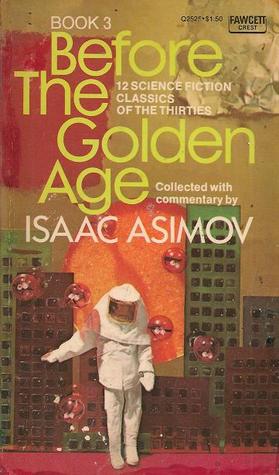
Asimov Book Review - Before the Golden Age

by Lacey Kat
(Copyright by author)

Isaac Asimov once wrote that he avoided writing an autobiography because he felt that nothing ever happen to him that would be of any interest to his readers. His editors continued to ask, however, so to blunt their pressure he started adding biographical information to some of his short story collections. Three books in particular; The Early Asimov, Buy Jupiter, and Before the Golden Age, form a literary autobiography from his early experiences with science fiction to his second marriage on November 30, 1973.

While Buy Jupiter and The Early Asimov contain works written by Isaac, Before the Golden Age is an anthology of stories that shaped his imagination, fired his interest in science fiction and lead him into the office of John Campbell, the man who is most responsible for the Asimov we have come to know and love.

In fact, the "Golden Age" that Asimov refers to began in 1938 when John Campbell became editor of Astounding Stories. He so dominated science fiction that to read Astounding was to know the entire field. This lasted until the early 50's when other magazines rose from the post war ashes, and science fiction spread to film, TV, books, and paperbacks. Never again could one person know the whole field of SciFi.

But before this space age Camelot there was a time when science fiction road the pages of the "pulp press." Cheap magazines made of wood pulp paper, unglazed covers, and ragged edges. Each about a dime, and devoted to a specific reader, there were Westerns, Detective stories, love and romance stories, and the kind of tales that would later inspire adventures from Flash Gordon and Indiana Jones. The magazines were cheap and they paid cheap. The authors were clumsy, primitive, and less than knowledgeable about their subjects. But then so were the readers. Remember, this was before cable TV.

Before the Golden Age (Doubleday (c) 1974) is a collection of these early science fiction short stories that graced the pages of such magazines as Science Wonder Quarterly, Astounding Stories of Super-Science, Air Wonder Stories, and Amazing Stories. It would be worth the 912 pages just for this look into an era of science fiction before real science, the years between 1931-1938. What makes this tomb a must read for Asimov fans is that between each story is a look at the writer in his early years. What he was doing when this story was published, and why it had so profound an impact on his early life and future writings. Remember, this was a time before Isaac decided to be a writer, let alone pursue science. To any Asimov fan, this book lets you see into what shaped his gift and why it went the directions it did. In these stories, you see glimpses of the Foundation, robots, and ugly little boys.

As a bonus, the stories in the book are still quite good. If you allow for the time written and the advance of knowledge over the years, each piece is as enjoyable now as when Isaac first read them in his father's candy store seventy years ago. This was a time when hard science did not have to get in the way of a story. When Venus was a tropical jungle filled with wild aliens. When the speed of light was not a barrier to ever increasing speed. When you could take your spaceship to the edge of the universe and find yourself on a giant glass slide, under a giant microscope, in another universe around the corner. It is a double education and worth ever
y cent.

[Update]  While the entire book is out of print, copies can be found on Amazon and eBay.  There is also a multi-volume set that was published later so if you are looking for the book be sure to ask if it is the original or one of the divided works.   (Examples to the right)


As I said in my review, these stories are not bad, given they were written by writers and not trained scientists, for the most part.   That "Hollywood" can't seem to find good stories to develop (see my scathing review of ABC's Masters of Science Fiction mini-series) is baffling
.

Friday, June 16, 2017

Asimov Book Review - The Naked Sun

by Lacey Kat
(Copyright 2016 by Author)

By the mid-1950’s Isaac Asimov was steadily moving away from science fiction, and devoting more time to non-fiction work. This trend had been steady through most of the decade beginning, if you will, with the publication of his book “Biochemistry and Human Metabolism.”

Asimov enjoyed writing and found that he enjoyed non-fiction more than fiction writing. In fiction, every story had to be different. In non-fiction, however, that was not the case. Asimov found he could write a technical paper for a science journal, popularize it for a broad appeal magazine, and even shorten and simplify it for a publication geared for a younger audience. The same article could serve many masters.

Asimov did not totally abandon non-fiction however and one of his better efforts during this time is the sequel to “Caves of Steel,” which he called, “The Naked Sun.”

“The Naked Sun” is the further exploits of New York detective Elijah Baley. Baley’s world is a thousand years from the time of the “Robot” stories Asimov wrote in the 1940s. Earth, as we found out in “Caves of Steel,” is over populated and mankind is forced to live in vast underground cities. Robots, once banned on earth, are slowly making their way into the everyday lives of the people in these cities.

However, earth is not the only planet humans call home. On fifty worlds out in space, humans have colonized and established various societies that are now more advanced than the lowly home of humanity. On these worlds robots are the norm. In fact, on Solaria, the population is held steady at twenty thousand people, but there are over two hundred million working positronic robots. That is a ratio of ten thousand to one.

[One cannot swing a dead cat without hitting a robot or finding the robot programmed to swing the dead cat]

The story opens with Detective Baley summoned to Washington. There has been a murder on Solaria and they have requested the help of the detective who solved another murder involving a “spacer.”

Washington has two reasons for assigning Elijah Baley to the case. The first is that the “spacers” requested him and earth is in no position to turn down such a request. The second reason is that little is known on earth about the “Spacer” worlds. Space travel is forbidden to any Earthman and the planet lives in isolation from the rest of the galaxy. Baley’s superiors see this as an opportunity to gather information on another planet.

Baley takes the assignment and is taken to the planet Solaria where he meets his former partner, R. Daneel Olivaw. This is a surprise to Baley because Daneel is not from Solaria, but from another spacer world called Aurora, and Daneel is not a human, but a humaniform robot. A fact that Baley alone seems to know about.

Solaria is a world of isolation. In many ways Asimov made it the direct opposite of the earth he created. Earth is overcrowded, as we learned in intimate detail in the previous novel. There is almost no time that a person is alone. Also, because the people of earth live in underground cities, they suffer from agoraphobia, the fear of open spaces. On Solaria each person has their own estate, and usually live alone. Robots tend to their every want, and advanced three- dimensional viewing is the only contact they have with other people. In fact “viewing” is such an accepted for of personal interaction that it takes a special effort to “see” someone in the flesh. Some Solarians can only take personal contact from a distance, and others become violently ill at the thought of a person actually being within their sight.

In this setting then comes the mystery. A prominent scientist is brutally murdered in his home, surrounded by robots that must not allow any harm to come to him. The only witness to the murder is a robot that can no longer function and has been destroyed. The only other human on the estate; his wife. A woman he can barely stand to be with.

This is a more mature novel than “Caves of Steel” in that it shows a development in Asimov’s novel style. In “Caves,” Asimov spent a large amount of time establishing the society of earth. In “Naked Sun,” Solaria’s society, knowledge of which is important to the mystery, is developed with the story. Baley, like the reader, is unfamiliar with this brave new world and must learn about it as he goes along. In this way, the reader, like the detective, must search through the information to see what is an important clue, and what is an abstract piece of information. In some cases, R. Daneel Olivaw is a source of information, but in reality, he plays a minor role in the overall story. It is the Plainclothesman Elijah Baley, with his policeman instincts that must solve the mystery and catch the killer.

Asimov has also sharpened his mystery writing skill a bit more for this novel. The solution is not as obvious and is not revealed as early as in “Caves of Steel.” There is a larger collection of suspects and they must all be examined in different ways. A fact that is itself a clue to the mystery (no, I am not giving anything away).

In the end, even though this story is set over a thousand years into the future, and over a hundred light years from earth, in the final chapter the intelligent detective must gather all of the suspects into “the library” to explain how the crime was committed, how the case was solved, and who the murderer is. Why Asimov resorted to this well-established cliché is unknown to me. He may have felt that it was obligatory for a murder mystery, but by this time in his career, he was more than able to challenge established propriety. It was well done and did not detract from the overall story, but it did reduce it a notch on the originality meter.

In the end “Naked Sun” is an excellent example of what Asimov thought science fiction should be. Not spaceships and laser guns, but a look at how technology affects society. Asimov successfully creates a planet where robots are so prevalent and human contact is so absent. A world where the basic needs of humans are bread out, but the basic needs of humans are the deciding factors in the case.

This was the second, and for the most part, last of the Elijah Baley mysteries. As stated above, Asimov was moving away from science fiction and more toward non-fiction. He would return to the Baley/ Daneel partnership thirty years later, but by that time he was using them to connect his “Robot” and “Foundation” stories and Asimov’s reason for the original pairing was lost. For this author it was a great loss indeed.

“The Naked Sun,” is a very good murder mystery and a very good science fiction novel. Isaac Asimov once again demonstrated how seamlessly these two genres’ could be fused together. He explores some pressing sociological issues without being heavy-handed

or preachy, and he provides a good story to boot.

How he does it so successfully is another mystery to be unraveled.

Monday, June 05, 2017

Asimov Book Review - Nightfall & Other Stories


by Lacey Kat
(Copyright 2016 by Author)


"If the stars should appear one night in a thousand years, how would men believe and adore: and preserve for many generations the remembrance of the city of God . . .."

Ralph Waldo Emerson 'Nature'

On March 17, 1941, John W. Campbell, Jr., then editor of "Astounding Science Fiction" met with a young Isaac Asimov, one of his stable of young writers. Asimov, who had just turned 21, had an idea for a story. Campbell, being the boss, had a better one. Campbell asked (so the story goes), "What do you think would happen if men were to see the stars for the first time in a thousand years?" Asimov, then quite naive on the ways of man, said, "I don't know." Campbell the said, "I think they would go mad." The two men talked a bit about the how & why of a world without stars, then Campbell sent the young, and only recently published, author out off his office with the orders, "Go home and write the story." And the rest, as they say, is history.

The story that evolved out of that meeting over sixty years ago is known as "Nightfall." It is considered by many to be the best science fiction short story of the twentieth century. It has won the Hugo Award and the Nebula, and readers" polls consistently place it in First place. By 1969 it had appeared in ten anthologies and was translated into Dutch, German, Italian, and even Russian (I say "even" because in 1969 the Cold War was still in full swing and neither Russia nor the U.S. printed much of the other's literary works).

As popular as it was, Asimov never included "Nightfall" in any of his collections until 1969. He also never considered it to be one of his best works. And therein lies a rub. At the "young" age of twenty-one, Asimov wrote a story so powerful that John W. Campbell Jr. actually gave him a bonus. It elevated Asimov to the level of "serious writer," it got him his first "cover," and from that point on he sold everything he wrote. The question was, where do you go from up?

Asimov himself once wrote that he was a little irritated at being told, over and over again, that "Nightfall" was his best story. He felt that time and practice should have made him a more polished writer in the passing years, and surely something else that he wrote should have surpassed this "dated" classic. The price of stardom at a young age.

To capitalize on his point Asimov put together this collection of twenty short stories. They cover the period of 1941 to 1968 and include stories that had not, at that time, appeared in any of his other collections. The stories vary in length and source. Some were published in leading Science Fiction Magazines of the time such as "Galaxy," "Astounding Science Fiction,"" New Tales of Space and Time," and "Fantastic." Others were first published in other sources such as "Scientific American" and the Netherlands medical magazine "Abbottempo." As he grew in fame periodicals of all kinds hoped to broaden their readership by including an "Asimov" story.

The first story, "Nightfall," deals with a planet, in a system of six suns that only sees a night sky once in two thousand and forty-nine years. And today is the day. In the span of thirty-two pages Asimov, using largely a conversation style introduces an alien civilization, gives you a history lesson, a quick look at the problems of astrophysics, examines the role of religion in society, and speculates on what you might do if you knew the world were coming to an end. For most writers, this would take a trilogy. [Note: In 1990 Robert Silverberg did expand the short story into novel length with the aid and approval of Asimov]

Each of the next stories, presented in the order they were published, takes a deferent look at a wide host of subjects. Asimov was never dull. What is particularly interesting in this collection is that Asimov has stories that include "alien" characters. This is unusual for the good Doctor as he usually populated his universes with humans only. However, in this collection, we see various attempts to present alien life with decidedly alien psychologies. In "Green Patches," for example, the alien life is a collective and sees man as too individual to do any good. In "C-Chute," a story that first appeared in "Galaxy" magazine and then was presented on radio, Asimov presents a war with an alien race that breaths chlorine and has a "hive" mentality. In "Hostess" the alien ambassador comes to dinner, much to the chagrin of the Hostess' husband. In "What is this thing called Love?" an alien that reproduces through budding must explain the concept of "sex" to his superior. So he grabs two earthlings off a train platform and asks for a visual aid. After reading these examples you may wonder why aliens are so scarce in Asimov's universe.

There is one robot story in the collection. It is called "Sally" and does not deal with the usual three laws conflicts.

One other story, that I found particularly interesting deals with the idea alternate universes. What would you do if you could see both outcomes of an important decision, and you did not like either one. Current Sci-Fi superstar Larry Niven wrote a host of stories dealing with contact with alternate realities, but that was over a decade after Asimov explored the idea. This story is also interesting as it has "romance" as a driving force. Asimov seldom had female characters in his stories, let alone romantic undertones.

"Nightfall and Other Stories" is a classic example of why Isaac Asimov was considered one of the great authors of the last century. Each story in the book starts with a brief biographical note explaining the history of the story. I have always enjoyed these glimpses into the life of the author and wish more would follow Asimov's example. What the book also shows is that Asimov was wrong. He did not get better with experience. He was a genius from the early stages of his writing. "Nightfall" shows how well developed his talent was at an early age. If you have not read "Nightfall and Other Stories," you have not read Asimov.

WARNING: In an effort to make more profit, I can only suppose, Grafton Books released "Nightfall One" and "Nightfall Two" in 1986. These are simply the original "Nightfall and Other Stories" split into two volumes. There is no new material, in either volume, and they were marketed primarily in England, New Zealand, and Australia. If you have "Nightfall and Other Stories", there is no reason to buy these.